Okay, for a general overview of (young) medieval women, the culture, and some ideas/misconceptions/cultural parameters about them, I do recommend Medieval Maidens: Young Women and Gender in England, 1270-1540. By its nature/title, it obviously focuses more on England, but France was not so terribly different culture-wise at this point, and this is around the time that most people think of as “medieval.” This book is fairly readable as academic texts go, and absolutely worth going through just for some basics.
In terms of warrior women, I will say that they are very much still the exception rather than the rule. They did exist, but there isn’t some grand conspiracy to cover up legions of Amazons and so forth (though it would be fun if there were). I work on the crusades, and one of the interesting questions is how much women participated as active combatants, if at all. Natasha Hodgson’s Women, Crusading, and the Holy Land in Historical Narrative covers some of this, though she mainly explores the interesting tensions about the presence/existence of women for crusade armies, and their relationships to crusaders – i.e. how much could women participate in a movement that by its nature was designed for arms-bearing knights, i.e. men? Helen Nicholson also has an article, Women on the Third Crusade, that deals with some cases of reported warrior women during said crusade (1187-1192) and what motives chroniclers, especially Muslim ones, might have for reporting or exaggerating their presence. This is a bit earlier, as the crusades are generally accepted to have taken place between 1095-1291, but still medieval.
In terms of French warrior women to look into, I’d say definitely Jeanne de Clisson (that is her wikipedia page, but there are links/references for further reading). She was a fourteenth-century French female pirate called the “Lioness of Brittany,” which if you ask me, is awesome, and everyone knows about Joan of Arc already. In this vein, Grace O’Malley was a 16th-century clan chieftain/pirate captain who met with Queen Elizabeth I; she couldn’t speak English and Elizabeth couldn’t speak Irish, so they communicated in Latin (also, in my opinion, awesome). She also had a badass nickname, “the Sea Queen of Connacht.” Not French, obviously, but yes.
Maud (or Matilda) de Braose was a 12th/13th-century Anglo-French noblewoman known for her military skill (in defending castles for her husband/leading armies in the field). She was supposedly exceptionally tall and also wore armor in fighting, and her death and that of her son (starvation by King John) so outraged the English nobility that there is a clause in the Magna Carta specifically banning such treatment of the king’s subjects. She also made enough of an impression that she is a Welsh folk legend.
Matilda of Tuscany is another woman (late 11th century) remembered for military accomplishments and formidable political prowess, especially in the Investiture Conflict.
Anyway, I think this is most of what I can come up with off the top of my head, but hopefully that is a useful start!
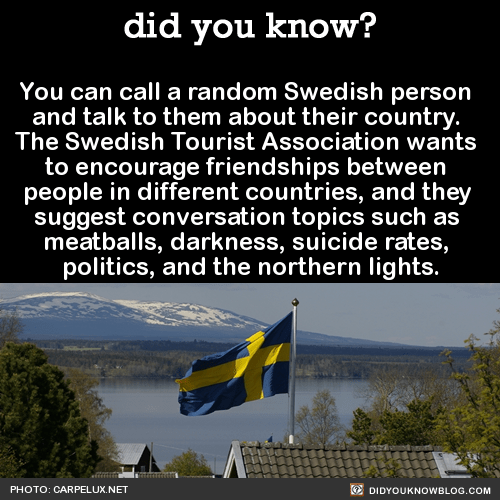
You can call a random Swedish person
and talk to them about their country. Just for fun. If you’re into that kind of thing.
Swedish Tourist Association CEO Magnus Ling says, “In troubled times, many countries try and limit communication between people, but we want to do just the opposite.”
“We are making Sweden the first country in the world with its own phone number and giving our fellow Swedes the opportunity to answer the calls, express themselves, and share their views, whatever they might be.”
To be connected to a random Swede, call +46 771 793 336. That’s +46 771 SWEDEN. Awwwww.
The 75 most common words make up 40% of occurrences
The 200 most common words make up 50% of occurrences
The 524 most common words make up 60% of occurrences
The 1257 most common words make up 70% of occurrences
The 2925 most common words make up 80% of occurrences
The 7444 most common words make up 90% of occurrences
The 13374 most common words make up 95% of occurrences
The 25508 most common words make up 99% of occurrences
This article has an excellent summary on how to rapidly learn a new language within 90 days.
We can begin with studying the first 600 words. Of course chucking is an effective way to memorize words readily. Here’s a list to translate into the language you desire to learn that I grabbed from here! 🙂
EXPRESSIONS OF POLITENESS (about 50 expressions)
‘Yes’ and ‘no’: yes, no, absolutely, no way, exactly.
Question words: when? where? how? how much? how many? why? what? who? which? whose?
Apologizing: excuse me, sorry to interrupt, well now, I’m afraid so, I’m afraid not.
Meeting and parting: good morning, good afternoon, good evening, hello, goodbye, cheers, see you later, pleased to meet you, nice to have met.
Interjections: please, thank you, don’t mention it, sorry, it’ll be done, I agree, congratulations, thank heavens, nonsense.
Space: into, out of, outside, towards, away from,
behind, in front of, beside, next to, between, above, on top of, below,
under, underneath, near to, a long way from, through.
Time: after, ago, before, during, since, until.
DETERMINERS (about 80 words)
Articles and numbers: a, the; nos. 0–20; nos. 30–100; nos. 200–1000; last, next, 1st–12th.
Demonstrative: this, that.
Possessive: my, your, his, her, its, our, their.
Quantifiers: all, some, no, any, many, much, more, less, a few, several, whole, a little, a lot of.
Universal: everyone, everybody, everything, each, both, all, one, another.
Indefinite: someone, somebody, something, some, a few, a little, more, less; anyone, anybody, anything, any, either, much, many.
Negative: no-one, nobody, nothing, none, neither.
ADVERBS (about 60 words)
Place: here, there, above, over, below, in front, behind,
nearby, a long way away, inside, outside, to the right, to the left,
somewhere, anywhere, everywhere, nowhere, home, upstairs, downstairs.
Time: now, soon, immediately, quickly, finally,
again, once, for a long time, today, generally, sometimes, always,
often, before, after, early, late, never, not yet, still, already, then
(=at that time), then (=next), yesterday, tomorrow, tonight.
Quantifiers: a little, about (=approximately), almost, at least, completely, very, enough, exactly, just, not, too much, more, less.
Manner: also, especially, gradually, of course,
only, otherwise, perhaps, probably, quite, so, then (=therefore), too
(=also), unfortunately, very much, well.
CONJUNCTIONS (about 30 words)
Coordinating: and, but, or; as, than, like.
Time & Place: when, while, before, after, since (=time), until; where.


 nomad-hermit