Okay but here’s the thing about bodyswaps
It’s usually explicitly one’s consciousness or literal soul being switched around, right? It’s not your actual, physical brain and brain chemistry
So what if one person has clinical depression and the other doesn’t? Someone’s probably got ADHD, is on the autism spectrum, has OCD or anxiety or PTSD. And maybe some of that follows the original owner, because they’re used to dealing with in unconsciously, but whoever replaced them is getting the brunt of it
Focusing on the physical aspect of bodyswaps is cool and all but let’s see some more on the psychological too?
I ALWAYS THINK ABOUT THIS.
I have literally always wondered what would happen if you body swapped an NT character with a dyspraxic one
Tag: interesting
Whenever I see a post on tumblr suggesting aliens don’t have gender, I always think–‘but what if also the reverse. What if aliens also have some fundamental social construct we don’t’.
Like, they come and meet us and they’re like ‘hey this is an awkward question but what’s your gooblebygark?’
And we’re like what.
‘You know, the… the thing. Your goobledygark. The thing that dictates whether you’re gnarfgnoovles or brubledoopes’
What. What. What the fuck, those words don’t even mean anything??? What are you talking about?
‘Look, your ridiculous human languages don’t seem to have the words for these! But they’re totally a thing, they’re like, fundamental aspects of social life for our species, just… just let us lick you so we can know what verb tense to use when we speak to you.’
What does one thing have to do with the other??? That makes no–
‘UGH, nevermind, you’re totally brubledoopes, I can just tell, I don’t even need to taste your bacterial skin colonies.’
And then another alien overhears and is like ‘holy shit, you can’t stereotype like that, that’s SO NOT COOL’
‘yeaH BUT THEY WON’T LET ME LICK THEM’
Get a rat and put it in a cage and give it two water bottles. One is just water, and one is water laced with either heroin or cocaine. If you do that, the rat will almost always prefer the drugged water and almost always kill itself very quickly, right, within a couple of weeks. So there you go. It’s our theory of addiction.
Bruce comes along in the ’70s and said, “Well, hang on a minute. We’re putting the rat in an empty cage. It’s got nothing to do. Let’s try this a little bit differently.” So Bruce built Rat Park, and Rat Park is like heaven for rats. Everything your rat about town could want, it’s got in Rat Park. It’s got lovely food. It’s got sex. It’s got loads of other rats to be friends with. It’s got loads of colored balls. Everything your rat could want. And they’ve got both the water bottles. They’ve got the drugged water and the normal water. But here’s the fascinating thing. In Rat Park, they don’t like the drugged water. They hardly use any of it. None of them ever overdose. None of them ever use in a way that looks like compulsion or addiction. There’s a really interesting human example I’ll tell you about in a minute, but what Bruce says is that shows that both the right-wing and left-wing theories of addiction are wrong. So the right-wing theory is it’s a moral failing, you’re a hedonist, you party too hard. The left-wing theory is it takes you over, your brain is hijacked. Bruce says it’s not your morality, it’s not your brain; it’s your cage. Addiction is largely an adaptation to your environment.
[…]
We’ve created a society where significant numbers of our fellow citizens cannot bear to be present in their lives without being drugged, right? We’ve created a hyperconsumerist, hyperindividualist, isolated world that is, for a lot of people, much more like that first cage than it is like the bonded, connected cages that we need.
The opposite of addiction is not sobriety. The opposite of addiction is connection. And our whole society, the engine of our society, is geared towards making us connect with things. If you are not a good consumer capitalist citizen, if you’re spending your time bonding with the people around you and not buying stuff—in fact, we are trained from a very young age to focus our hopes and our dreams and our ambitions on things we can buy and consume. And drug addiction is really a subset of that.
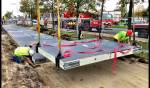
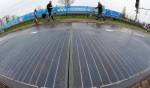


Remember the Netherlands’ solar bike path? Well, it’s been a huge success
SolaRoad’s 70-meter test track near the town of Krommenie outside Amsterdam has generated over 3,000 kilowatt-hours over its first six months of operation, or “enough to provide a single-person household with electricity for a year.” This is the first step towards a very bright future.
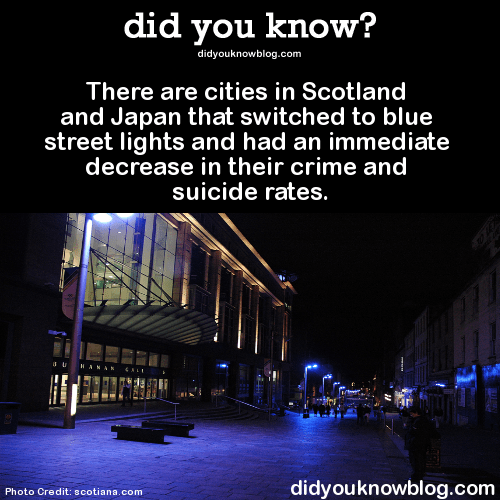
Some suggest this happens because blue is a “calming color,” but others argue it’s just because nobody wants to draw attention to themselves by being suspicious under the special lights.
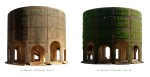
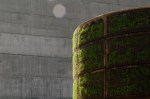

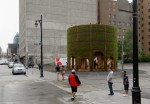
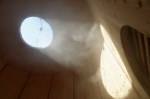


Raumlabor . Fountain House. Montreal. Canada. photos © Raumlabor
Reexamining the fountain: The project wishes to re-address the notion of the public good by celebrating free access to it. The fountain house is to be a place for this celebration to find a place and a shape. To give it a presence in public-shared city spaces. The Fountain House, with it’s open ground plan, overlapping archways for entering and accessible rooftop offers a space for various kinds of public use. © Raumlabor more here
 nomad-hermit